Splash Buster
- 4.7
- Rating
- 10.00K
- Installs
- Free
- Price
 Analysis by App-foxy
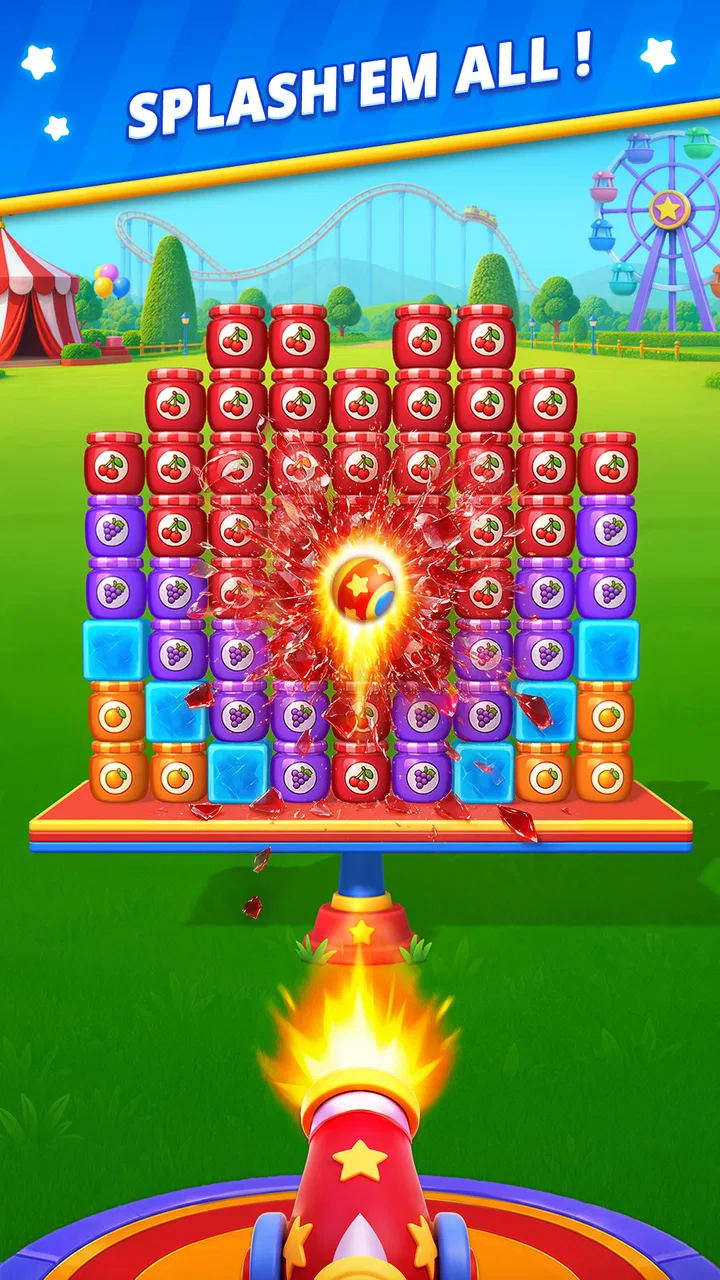
I went into Splash Buster expecting a quick puzzle game, and that is exactly where it makes the best first impression. The basic idea is easy to understand: position a cannon, fire into a three-dimensional scene, and look for a chain reaction that clears the puzzle. It feels approachable from the first tap, but the physics give each shot enough uncertainty to make success satisfying rather than automatic.
This is a free puzzle game from Nebula Studio, aimed at an Everyone audience. It is a sensible choice for short breaks because the central interaction is immediate and does not require a long explanation before you can try it. At the same time, it is not just a button-pressing exercise. The interesting part is learning how the objects in each scene respond, then adjusting your aim so one action causes several useful results.
Getting from the first launch to a meaningful win
I’d treat the first launch as a chance to learn how the scene responds, not as a race to clear it. Looking for a target that can pass an impact along gives each attempt a purpose, even when it does not work on the first try. Once that basic rhythm clicks, it becomes easier to decide whether another shot fits the moment or whether to come back later.
You May Also Like

 Blood Strike: 2.5 Anniversary
Blood Strike’s Loadouts Turn Every Drop Into a Tactical Gamble
A close look at Blood Strike’s custom loadouts: how fast access to signature weapons reshapes its battle royale rhythm, rewards preparation, and narrows the gap between fights.

 Pandora - Music & Podcasts
Pandora’s Music Is Easy to Start, but Harder to Recover
Pandora’s strength is its low-effort path from a seed to a station. Its weak spot is how much confidence it asks you to place in connection, setup, and quiet recovery.

 8 Ball Pool
 Is Built on Rivalries, Rematches, and Routine
A close look at the rivalries, rematches, shared routines, and unanswered safety questions that turn a quick pool match into a persistent mobile community.

 Samsung Music
’s Quiet Strength Is Playing What You Already Own
Its reach comes less from spectacle than from dependable access to a personal library. That simplicity is both the app’s strongest retention engine and its ceiling.

 AccuWeather: Weather Radar
AccuWeather Review: A Quick, Clear Forecast for Everyday Decisions
For everyday plans, the best forecast is the one you can understand quickly. AccuWeather makes rain timing, radar, and local conditions easy to act on, with a few trade-offs.

 Hill Climb Racing
Why Hill Climb Racing Still Turns Crashes Into One More Run
A tiny car, a bumpy hill and one more upgrade: Hill Climb Racing keeps resurfacing because its simple chaos makes every near-miss feel personal.
More From Our News Desk
View All News


What the first session feels like
The opening experience is built around experimentation. You are not asked to memorize a complicated control scheme or manage a large collection of characters and menus. Instead, your attention goes straight to the cannon and the puzzle arrangement in front of it. That makes the game friendly to people who rarely play mobile games, including anyone looking for something that can be understood without reading a long tutorial.
My advice for a first attempt is to resist firing immediately. Spend a moment looking at the full scene and identify the objects that appear to connect the most pieces. In a physics puzzle, the most visible target is not always the best target. A lower object, a side barrier, or a packed cluster may offer a better starting point because it can send movement through the rest of the arrangement.
The game’s appeal comes from this small planning pause. A direct hit can work, but the more memorable successes come from noticing how one impact might affect several nearby elements. That makes each level feel like a compact problem rather than a simple test of reflexes.
Because the game is free to install, it is easy to try without committing money at the beginning. There are optional in-app purchases ranging from $0.99 to $99.99 per item, so I would still recommend checking the purchase flow before handing the phone to a child. The Everyone rating makes the game broadly suitable in tone, but an age rating does not remove the need for ordinary device purchase safeguards.
Setting up without overthinking it
The installation barrier is low for compatible devices, with Android support beginning at version 7.1. On a phone that meets that requirement, the practical setup is simply to install the game, open it, and begin learning the aiming interaction. I would keep the first session focused on controls rather than trying to optimize every shot. The goal is to understand how the cannon responds and how much influence the angle has on the final result.
That distinction matters. In many familiar puzzle games, the player mainly chooses a matching piece, rotates a shape, or follows a fixed path. Here, the result depends on both the selected direction and the physical response after impact. If your first shot misses, that does not necessarily mean the puzzle is badly designed or that you misunderstood the objective. It may show that your angle was close but not quite useful.
I found it helpful to treat the first few attempts as observation rather than failure. Watch where the projectile makes contact, notice which objects move, and use that information on the next shot. This is especially useful when the ideal route is not obvious from the starting view. A small change in direction can turn a weak impact into a chain reaction.
The current version is 1.0.4, which is worth checking when troubleshooting. If the game behaves differently from what you expect, confirming that the installed version is current is a sensible first step. I would also avoid judging the entire experience from a single rushed attempt; the game’s central mechanic becomes clearer once you deliberately compare two or three different angles.
How to get the first successful chain reaction
For a first meaningful success, I would use a simple three-stage routine. First, scan for the densest group or the object that seems to sit between several others. Second, aim for the point that should transfer the most movement, rather than automatically choosing the largest visible target. Third, fire once and observe the result before making another adjustment.
This approach helps because it separates aiming from guessing. If the cannon is pointed too directly at an isolated object, the impact may stop there. If you aim toward a connected group, the same shot has a better chance of producing the satisfying cascade that defines the game. The best early lesson is not “always shoot the center”; it is “look for the object that can pass the impact onward.”
When a shot partly works, do not immediately repeat it at the same angle. Ask what actually happened. Did the first object move but fail to reach the next one? Did the projectile enter the group from the wrong side? Did the reaction begin correctly but lose force before reaching the final pieces? Those observations give you a practical adjustment for the next attempt.
I also recommend using the edges of the scene as reference points. Aiming can feel vague when you focus only on the cannon and target, but the surrounding layout gives you a visual frame for judging direction. This is a small habit, yet it makes the controls feel less random and helps new players build confidence quickly.
Where new players may become confused
The most likely confusion is expecting every puzzle to reward a straight shot. Splash Buster is more interesting when you think in terms of consequences. The cannon is only the beginning of the move; the real question is what the impact will cause afterward. A shot that looks impressive at the first contact may be less effective than a quieter hit that reaches a crowded section.
Another possible sticking point is the physics themselves. Objects may not respond exactly as they would in a perfectly predictable diagram, so repeating a nearly identical shot can produce a slightly different result in practice. I see that as part of the appeal, but players who prefer completely deterministic puzzle rules may find it frustrating. If you want every outcome to follow a fixed sequence, a traditional grid-based matching game may suit you better.
It is also easy to mistake a failed chain reaction for a control problem. Before blaming the aim, check whether the chosen target was actually connected to anything useful. Sometimes the angle is reasonable, but the selected impact point simply cannot move the rest of the scene. Reframing the puzzle around connection and momentum usually helps more than making a tiny adjustment to the cannon.
Because the game is designed for an Everyone audience, I would not expect it to depend on mature themes or complicated narrative context. That is a strength for casual play, but it also means the motivation comes mainly from solving the physical arrangement. Players who need a story, character progression, or a large competitive system may find the experience too focused.
Useful habits after the first win
Once you have completed an early puzzle, the next step is to become more deliberate. Instead of trying to finish as quickly as possible, compare the safe shot with the efficient shot. A safe shot may clear one nearby obstacle, while an efficient shot can start a broader reaction. Learning that difference gives the game more depth without requiring complicated controls.
One useful habit is to identify a backup plan before firing. If the ideal angle is difficult, decide which secondary target you can hit without wasting the attempt. This prevents you from staring at the scene indefinitely and gives each shot a clear purpose. It is particularly helpful during a short break, when you want thoughtful play without turning one puzzle into an extended planning session.
Another tip is to change one variable at a time. If you alter the angle, target, and timing together, you will not know what improved the result. Adjusting only the direction makes the physics easier to read. Over several attempts, this turns trial and error into a simple learning process.
I would also play with sound and attention in mind. In a busy environment, the visual movement is more important than trying to react to every small effect. If you are playing while commuting or waiting for an appointment, choose a puzzle when you have enough focus to inspect the arrangement, then pause between attempts rather than firing repeatedly. The game works best as a compact thinking activity, not as background tapping.
Who will enjoy it most
Splash Buster is a strong fit for players who enjoy compact physics puzzles and the feeling of discovering a clever angle. It is especially accessible for someone who wants to try a game without learning a large ruleset. The free entry point also makes it easy to test whether the cannon-and-chain-reaction formula matches your taste before spending anything.
It can work well in everyday situations where you have a few spare minutes. For example, I would use it while waiting for a coffee order: inspect one scene, make a considered shot, and decide whether the result deserves another attempt. The game’s central loop is small enough for that setting, yet the physics give it more thought than a purely automatic time-killer.
It is less suitable for someone seeking a long-form adventure, a deep story, or a highly social multiplayer experience. It may also disappoint players who prefer puzzles with one completely predictable solution and no physical variation. In those cases, a logic grid game or a classic match-three title would probably provide clearer rules and more immediate repetition.
How it compares with familiar puzzle alternatives
Compared with match-three games, this one shifts the focus from pattern recognition to spatial planning. You are not mainly searching for identical symbols; you are considering impact, direction, and what happens after contact. That makes it feel more tactile and gives a successful move a stronger sense of cause and effect.
Compared with traditional physics puzzlers, the cannon provides a direct and readable starting point. You do not need to manage a complicated construction system before seeing the result of your idea. The trade-off is that the experience may feel narrower if you want many different tools or elaborate multi-step machinery. Its strength is concentration: one cannon, one arrangement, and a decision about where the reaction should begin.
Compared with endless casual games, Splash Buster asks for more attention per move. That is good when you want a small mental challenge, but it is not ideal if your priority is constant action with no pauses for planning. I would choose it over a passive time-killer when I want to feel that I solved something, but I would choose a faster arcade game when I only want immediate motion.
Practical expectations about access and spending
The game is free, so the sensible approach is to play enough to decide whether the core physics are enjoyable before considering any optional purchase. The listed purchase range is broad, from $0.99 to $99.99 per item, and that makes purchase awareness important even though the game can be started without an upfront fee.
I would enable the device’s purchase confirmation, particularly on a shared tablet or a child’s phone. I would also treat any optional spending as a convenience rather than a requirement for learning the basic mechanic. The most valuable part of the experience is understanding the scene and improving your aim, not rushing through the early learning process.
The current audience rating of Everyone makes it an easy recommendation for family-friendly casual play, while the minimum Android requirement of 7.1 keeps the technical entry point relatively broad. The developer is Nebula Studio, and the game has reached over 10K installs with a 4.7 average from 48 ratings. Those figures suggest a positive early reception, although I would still base my decision on whether you enjoy physics-based aiming rather than on the rating alone.
My recommendation after spending time with it
What I like most is the way Splash Buster turns a single cannon shot into a small prediction exercise. The controls are approachable, but the best results come from thinking beyond the first collision. That combination makes it easy to start and gives careful players a reason to keep experimenting.
My main reservation is equally clear: the physics-focused design will not satisfy everyone. If you dislike outcomes that require adjustment, or if you want a broad progression system around the puzzles, you may prefer a more conventional alternative. The optional purchase range also means I would approach spending carefully, even though the initial download is free.
For a first-time user, my path would be simple: install it on a compatible device, inspect the first scene before firing, aim at a connected area instead of the most obvious object, and use each result to change only one part of the next attempt. That routine gets you to the first rewarding chain reaction without making the game feel intimidating.
Overall, I recommend Splash Buster to anyone who wants a compact puzzle game where planning and physical cause-and-effect matter. It is not trying to replace a story-driven game or a deep strategy title. Its appeal is more focused: a quick setup, a clear cannon, and the pleasure of watching a carefully chosen impact travel through a three-dimensional puzzle.
FAQs for Splash Buster
01What is Splash Buster and how does the game work?
Splash Buster is a casual action game centered on quick reactions, colorful visual effects, and splash-based gameplay. After installing it, players generally progress through short levels or challenges by tapping, aiming, avoiding obstacles, or matching the correct timing. The controls are designed to be easy to understand, although later stages may require faster decisions and more precise movements.
02Is Splash Buster free to download and play?
Splash Buster can usually be downloaded without an upfront payment, but the exact monetization model may depend on the version available for your Android or iOS device. Free games of this type may include advertisements, optional in-app purchases, extra lives, cosmetic items, or other boosts. Before confirming a purchase, review the store listing and your device’s payment settings.
03Does Splash Buster require an internet connection?
The basic gameplay experience may work without a constant internet connection, which is useful when you want to play during travel or in areas with limited coverage. However, certain features can require online access, including advertisements, cloud synchronization, leaderboards, updates, events, or purchases. Availability may also change between versions, so test the game offline after installation.
04Is Splash Buster suitable for children and younger players?
Splash Buster appears to be approachable for casual players because its gameplay is simple to learn and does not usually require advanced gaming experience. Nevertheless, parents should check the age rating, advertising content, data permissions, and available in-app purchases before allowing children to play. If the game includes competitive features or purchases, parental controls are recommended.
05What should I check before downloading Splash Buster?
Before downloading Splash Buster, verify that your device meets the current operating-system requirements and has enough free storage for the installation and future updates. It is also worth checking recent user reviews, the developer information, privacy details, and whether the game contains ads or optional purchases. Downloading only through the official Google Play Store or Apple App Store is the safest option.
Pros
- Fast-paced levels are easy to start and play in short sessions.
- Simple controls make the game accessible for most players.
- Bright visuals and splash effects give it a cheerful style.
- Increasing challenges help keep the gameplay engaging over time.
- Works well as a casual game for quick entertainment breaks.
Cons
- Gameplay may feel repetitive after extended play sessions.
- Some levels can become frustrating without careful timing.
- Progress may feel slow for players who prefer constant rewards.
- The colorful effects can make busy scenes harder to read.
- It may offer limited depth for users seeking a complex game.

Splash Buster
Gallery